
What Keeps Us Going Under Pressure?
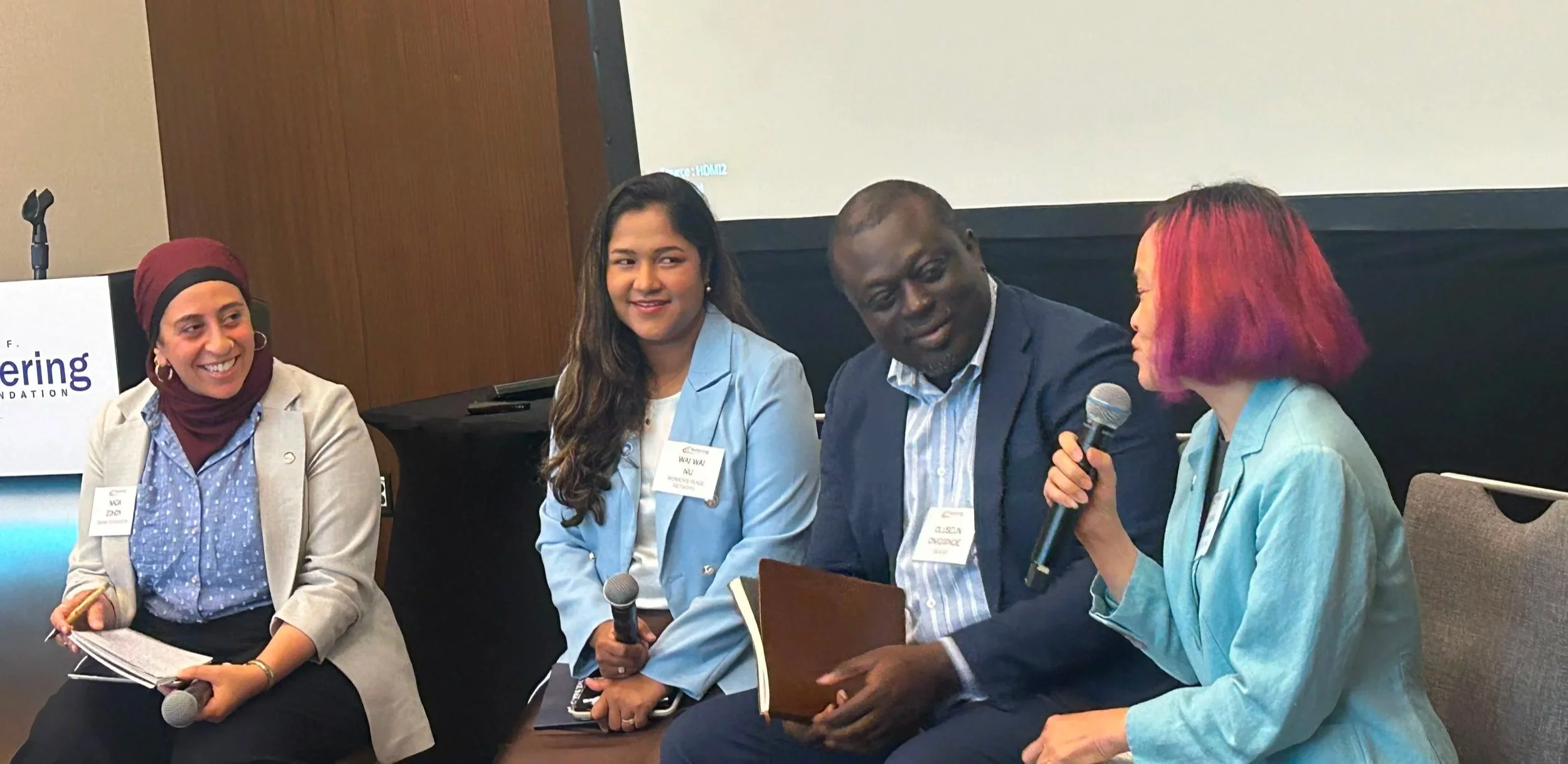
Hong Hoang in conversation with Wai Wai Nu and Oluseun Onigbinde, moderated by Nada Zohdy, at the Kettering Foundation, July 2026.
By Hong Hoang
In July 2026, I joined a conversation at the Kettering Foundation’s Solidarity Across Borders: Meeting the Moment, alongside fellow Obama Scholars Wai Wai Nu from Myanmar and Oluseun Onigbinde from Nigeria. Nada Zohdy moderated our discussion.
Three different countries, three different movements. Wai Wai works on democracy, peacebuilding, and the rights of marginalized communities in Myanmar, having spent seven years as a political prisoner. Olu has pioneered the use of data, transparency, and citizen engagement to fight corruption and strengthen public accountability across Africa.
Yet our conversation kept returning to the same question: what actually keeps people going when democracy is under pressure?
The space climate action depends on
For many years, I believed I was “just” an environmentalist. Climate, wildlife, pollution. I thought that if we focused on solving those problems, we could stay out of politics.
I was wrong.
The biggest obstacle we faced was not a lack of ideas or solutions. It was civic space quietly shrinking around us. Once that happens, everything gets harder. Climate action, education, public health, and human rights all depend on whether people can organize freely, participate in decisions, and ask difficult questions without fear.
That connection is central to ECHO Alliance’s work. Supporting climate and environmental action also means supporting the people doing it, including when they face pressure for speaking up.
The relationships that carry us through
We also talked about solidarity. For me, solidarity is a strategy, built through relationships and trust.
One of the things that helped me endure prison was learning that people had not forgotten me. Friends, colleagues, members of the Obama Foundation’s Leaders community, environmental and human rights organizations, governments, and thousands of people I had never met came together through the FreeHong campaign.
That response grew from relationships built over many years. People knew one another, trusted one another, and found ways to act together when it mattered.
My experience also showed me how difficult it can be for families and colleagues to navigate a crisis. Even with extraordinary public support, practical needs can go unmet. Building stronger support networks means paying attention to both.
When the work changes shape
Finally, we spoke about what comes after.
Exile forced me to leave behind so much of what I had spent my life building. But my work continued in a different form.
Today, through writing, speaking, mentoring, and ECHO Alliance, I am working to help others find the connections and support that helped me carry on. ECHO brings together people whose experiences of organizing, facing pressure, and supporting others shape how we work with communities.
One thought has stayed with me since the conversation: one of the biggest threats to civic life is exhaustion. Under constant pressure, people become worn down. They quietly stop showing up, and their communities lose voices, relationships, and leadership they cannot easily replace.
Helping people sustain their work is therefore part of sustaining the movements and communities around them.
My thanks to Nada for bringing us together, and to Wai Wai and Olu for such an honest and thoughtful exchange. Our conversation reminded me that the support people need in a crisis often begins with the relationships we build long before one arrives.
